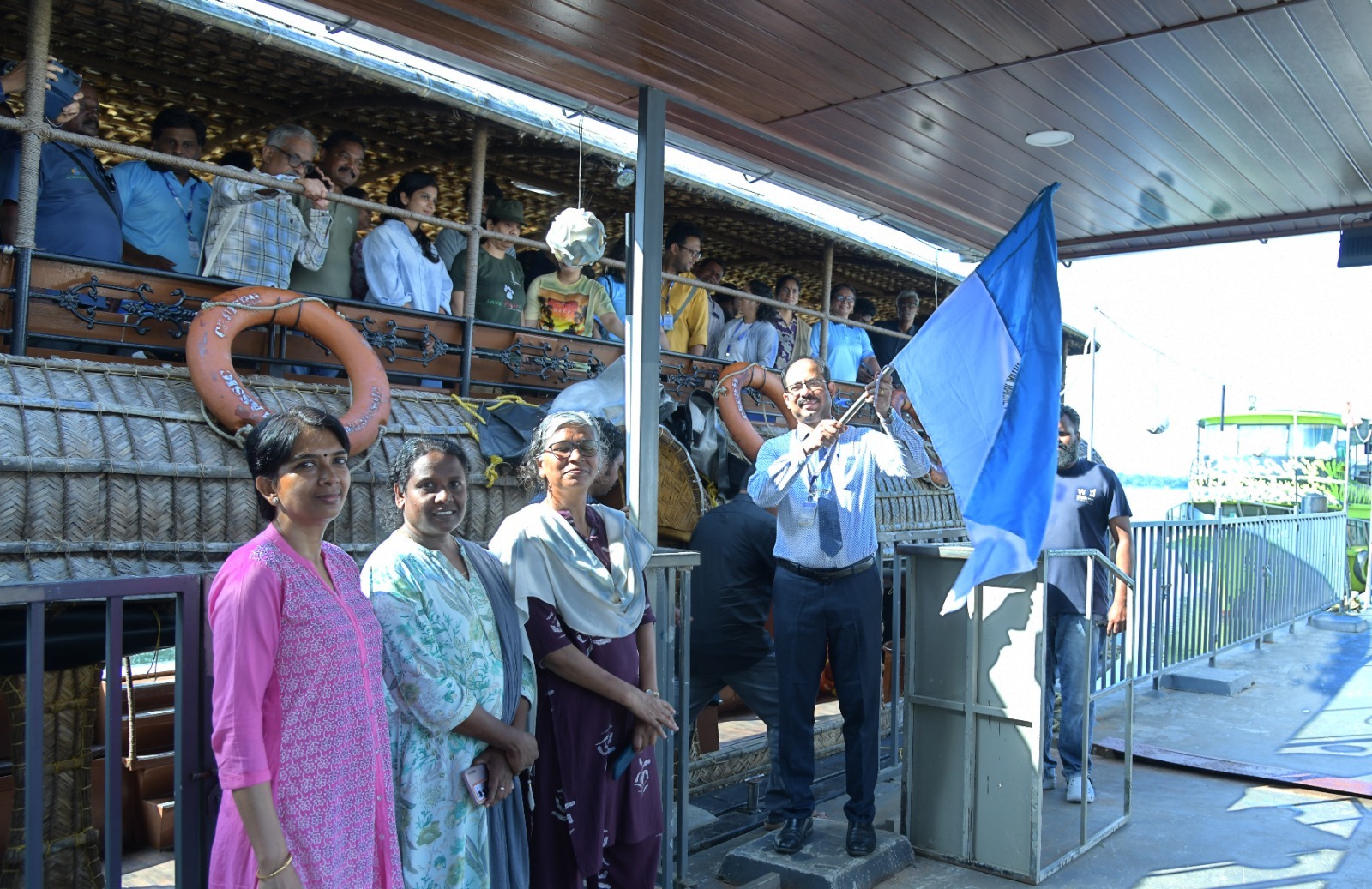
Kochi, Sep 29 (SocialNews.XYZ) The ICAR-Central Marine Fisheries Research Institute (CMFRI), a national institute under the Indian Council of Agricultural Research, took a team of people on a journey through the lesser-seen ecological world of Kerala's Vembanad lake as part of the nationwide Swachhata Hi Seva 2026 campaign, covering 15 islands, nearly century-old mangroves, and traditional Pokkali fields.
The backwater cruise from Marine Drive to Kadamakkudy, organised in connection with World Tourism Day, offered students, researchers, teachers, tourism professionals, and nature enthusiasts an opportunity to see how the mangroves, wetlands, fisheries, and traditional livelihoods of Vembanad remain closely interconnected.
As the boat moved through the islands, the familiar image of Vembanad as a vast expanse of water gave way to a more complex landscape.
At Korangot, participants encountered mangroves that have stood for decades, some of them nearly a century old.
Their large trunks and tangled roots revealed an ecosystem that is far more than vegetation growing along the water's edge.
CMFRI scientists explained how mangroves act as natural barriers against storm surges and coastal flooding.
The trees also provide breeding and nursery grounds for fish and other aquatic organisms, store carbon, and help protect coastal ecosystems from the effects of climate change.
For many participants, these ecological functions became tangible rather than something learnt from photographs or textbooks.
The journey to Pizhala offered another glimpse into the relationship between the backwaters and human life.
The Pokkali fields represent a farming system shaped by the changing salinity of the estuary.
Salt-tolerant rice is cultivated during one season, while the fields are used for fish and prawn farming during another.
Agriculture and fishing thus follow the natural rhythm of Vembanad.
But the cruise also revealed the pressures facing the fragile ecosystem.
A clean-up drive drew attention to the presence of plastic and other waste in the backwaters.
Discussions covered pollution, wetland conservation, aquatic biodiversity, cage fish farming, and the sustainable use of natural resources.
The Vembanad ecosystem supports much more than its fish and mangroves.
It sustains island communities, traditional farming practices, and livelihoods that have evolved around the water over generations.
The mangrove, the Pokkali field, the fish, and the people are not separate stories.
They are parts of the same ecosystem.
That interconnectedness was at the heart of CMFRI's Fish Walk initiative, which takes scientific knowledge out of laboratories and classrooms and into the natural habitats being studied and conserved.
CMFRI Director Dr Grinson George flagged off the cruise from Marine Drive Jetty.
MLA Tony Chammany interacted with participants at the Kadamakkudy Pokkali fields.
"CMFRI’s Fish Walk is designed as a series of innovative ways of exploring aquatic life and biodiversity, aimed at taking the message of conservation to a wider audience through engaging and experiential approaches," said Dr Mirium Paul Sreeram, coordinator of the initiative.
Source: IANS
Gopi Adusumilli is a Programmer. He is the editor of SocialNews.XYZ and President of AGK Fire Inc.
He enjoys designing websites, developing mobile applications and publishing news articles on current events from various authenticated news sources.
When it comes to writing he likes to write about current world politics and Indian Movies. His future plans include developing SocialNews.XYZ into a News website that has no bias or judgment towards any.
He can be reached at gopi@socialnews.xyz
This website uses cookies.


